Modern regex features
\(r ::= \varepsilon~|~c~|~r{\cdot}r~|~r{\shortmid}r~|~r*\)
- + capture groups:
a(b*)c- + backreferences:
^(.+)\1+$- + lookarounds:
Beg((?!End).)*End- = lots of ReDoS

Supervised by Aurèle Barrière, CNRS and Clément Pit-Claudel, EPFL

a(b*)c^(.+)\1+$Beg((?!End).)*End| Regex dialect | Complexity class |
|---|---|
| Textbook regexes | \(\in\) P |
| Modern-regex folklore | NP-complete (wrong!) |
| [Uezato 24] | PSPACE-complete |
| Real-world regex matching | This work! |
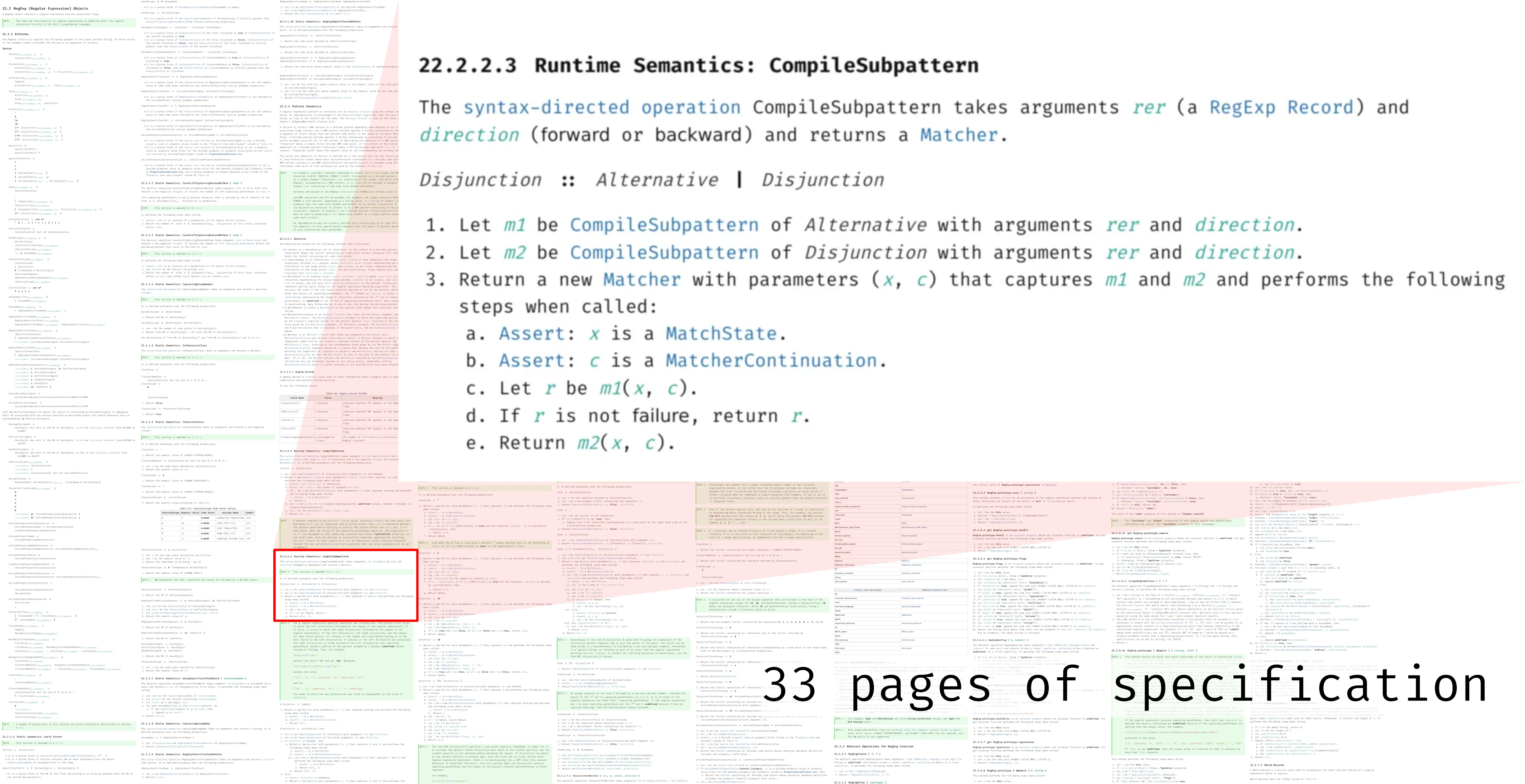
 \(\Leftrightarrow\)

Can we say something about matching and parsing complexity for a real, large specification?
Contributions: We give the first complexity results for a modern regex language, against a realistic semantics, with mechanized reductions and bounds on computation depth, using a new construction with no explicit negations.
Reduction from SAT [Dominus 98]: \[ \begin{align*} \varphi =~&({\color{blue}x_1} \lor {\color{green}x_2}) \land \neg {\color{green}x_2} \\ r =~&\langle (_1 \texttt{\color{blue}a})|\texttt{\color{blue}a} \rangle \texttt{;}\langle (_2 \texttt{\color{green}a})|\texttt{\color{green}a} \rangle \texttt{;} & \text{sets $x_1$ and $x_2$} \\ & \langle {\color{blue}\backslash{}1}|\backslash{}2 \rangle\texttt; & \text{checks $x_1 \lor x_2$} \\ & \backslash{}2\texttt{\color{green}a}\texttt; & \text{checks $\neg x_2$} \\ s =~&``\texttt{{\color{blue}a};{\color{green}a};{\color{blue}a};{\color{green}a};}" \end{align*} \]
Extension to QBF (adapted from [Uezato 24]): \[ \begin{align*} q =~&\exists {\color{blue}x_1}. \neg\exists {\color{green}x_2}. ({\color{blue}x_1} \lor {\color{green}x_2}) \land \neg {\color{green}x_2} \\ r =~&\langle (_1 \texttt{\color{blue}a})|\texttt{\color{blue}a} \rangle \texttt{;} \textbf{\color{red}(?!} \langle (_2 \texttt{\color{green}a})|\texttt{\color{green}a} \rangle \texttt{;} \langle \backslash{}1|\backslash{}2 \rangle\texttt; \backslash{}2\texttt{a}\texttt;\textbf{\color{red})} \\ s =~&``\texttt{\hspace{3.85mm}{\color{blue}a}\hspace{3.85mm};\hspace{10mm}{\color{green}a}\hspace{4.5mm};\hspace{4.5mm}a\hspace{4.4mm};\hspace{2mm}a\hspace{1.5mm};}" \end{align*} \]
Key idea: use atomic lookarounds.
Atomic lookarounds: if \(A\) succeeds but \((?{=}A)C\) fails, then \((?{=}A|B)C\) will not backtrack to try \((?{=}B)C.\)
\[ \begin{align*} q =~&\exists {\color{blue}x_1}. \neg\exists {\color{green}x_2}. ({\color{blue}x_1} \lor {\color{green}x_2}) \land \neg {\color{green}x_2} \\ r =~&\langle (_1 \texttt{\color{blue}a})|\texttt{\color{blue}a} \rangle \texttt{;} \textbf{\color{red}(?{=}} \langle (_2 \texttt{\color{green}a})|\texttt{\color{green}a} \rangle \texttt{;} \\ &\langle \backslash 1 | \backslash 2 \rangle\texttt; \backslash 2 \texttt{a;} \\ &\mathbf{\color{red} | \langle \texttt{a;}\rangle{*}\textbf(_\mathit{z} \texttt{z}\textbf{))}} {\color{purple} \langle \texttt{a;}\rangle{*}\backslash k\langle z \rangle \$} \\ s =~&``\texttt{{\color{blue}a};{\color{green}a};a;a;z}" \end{align*} \]
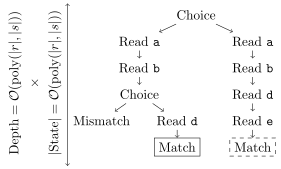
New argument: bound the recursion depth
and the size of the arguments of the
recursive backtracking algorithm by
a polynomial of \(|r|\) and \(|s|\).
1. Model \(\mathrm{QBF}_{\neg\exists}\)
Definition qbf: Type :=
  list quantifier * formula.
Definition qbf_true
  (q: qbf): Prop :=
  (* ... *).
2. Encode reduction
Definition def_var_regex
  (v: variable): regex :=
  Sequence
    (Disjunction (Group v (Char a))
      (Char a)) (Char semicolon).
(* ... *)
3. Prove vs. Linden semantics
Theorem qbf_regex: forall q,
  accepts (regexOf q) (stringOf q)
  <-> qbf_true q.
4. Bound computation depth
Theorem tree_depth_bound:
  forall r s t, is_tree r s t ->
    tree_depth t <= 2*(1 + (
      (1 + |s|ₛ) * |r|ᵣ +
      (1 + |s|ₛ) * |r|ᵣ^2)).
\(\footnotesize\hspace{.75cm}= \mathcal{O}(|s| \cdot |r|^2)\)
OptP [Krentel 86]: functions computed as the maximum output over the accepting branches of an NP Turing machine.
New result: regex parsing without lookarounds is OptP-hard.
Proof: by reduction from a canonical OptP-complete problem.
Reduction from SAT
+ backtracking semantics
= reduction from LEXICOGRAPHIC SAT
New result: regex parsing without lookarounds is in OptP.
Proof: We bound the execution time of an NP algorithm that produces the branch history. It uses a checker that takes as input a bitstring of choices, returns it if it leads to a match and rejects otherwise.
[1]: N. De Santo, A. Barrière and C. Pit-Claudel, "A Coq Mechanization of JavaScript Regular Expression Semantics," ICFP'24.
[2]: A. Barrière, V. Deng and C. Pit-Claudel, "Formal Verification for JavaScript Regular Expressions: A Proven Mechanized Semantics and Its Applications," POPL'26.
[Uezato 24]: Y. Uezato, "Regular Expressions with Backreferences and Lookaheads Capture NLOG," ICALP'24.
[Dominus 98]: M. J. Dominus, "Perl Regular Expression Matching is NP-Complete," 1998.
[Krentel 86]: M. W. Krentel, "The complexity of optimization problems," STOC'86.